 Eli "fetsh" Heiman
Working in a Hospital: Somewhere Between a Flight Attendant and a Nurse
Before making aliyah to Israel, I worked in tech as a programmer. But after moving, I realized that since I had already changed my life so drastically, I might as well change what I did for a living too. I had grown pretty tired of programming: tired of sitting in front of a computer all day and building things I had no real interest in building. So I decided to move into a field that felt much more understandable and much closer to me.
Now I work in a hospital. My position is called “support staff” — כוח עזר in Hebrew. Very roughly speaking, I am somewhere between a flight attendant and a nurse. I help patients, help the nurses, and make sure the ward functions the way it is supposed to.
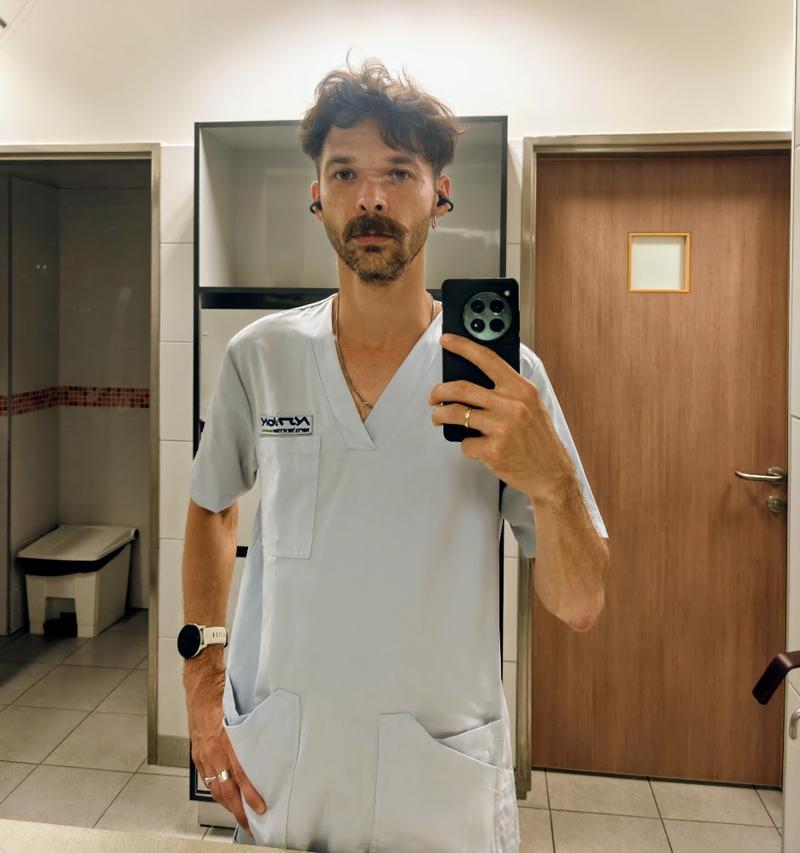
Our hospital specializes in surgery. Practically every department apart from the operating rooms is a place where patients recover after surgical procedures.
I work in the urology and ENT ward. So half of my patients are men recovering from prostate or bladder surgery, lying in bed with catheters. The other half are women and children with noses, ears, and various consequences of head and neck surgery.
Morning
When I arrive for a morning shift, the first thing I do is help newly admitted patients get out of bed for the first time after surgery. They are not allowed to do it on their own.
Many urology patients have a continuous saline irrigation system connected to their catheter throughout the night. Large bags of saline slowly flush the surgical site, and the fluid comes back out through the catheter. If the colour of the fluid looks normal and does not resemble tomato juice too much, I disconnect the irrigation.
After that, the usual routine begins: handing out towels and pyjamas and changing the bed linen. After surgery, the sheets are often covered in either blood or shit, and sometimes both at once. If someone needs help taking a shower, I help them shower.
When a new patient arrives on the ward after surgery, I receive them. I introduce myself, help them settle in, organize the catheters, IV lines, and wires, bring them water, prepare saline for irrigation, and generally try to make sure they do not feel abandoned in the middle of a pile of medical equipment.
Every patient has a button for calling the staff. When it beeps, I am usually the first person to arrive.
Sometimes a patient simply needs help moving to a chair, some water, help finding a charger, or a pillow adjusted. Sometimes the issue is medical, and then I pass it on to the nurses or doctors.
Food
Three times a day, the patients need to be fed.
We deliver the trays, collect them afterward, ask people what they want from the menu, place the orders, and make sure nobody is left hungry.
Working with catheters
A significant part of life in a urology ward revolves around urine.
Special bags are attached to the catheters to collect it. I empty or replace them and record the volume. We need to know how much urine a patient has produced and what colour it is.
Surprisingly quickly, you stop seeing these things as anything unusual. It is simply another indicator of a person’s condition, just like temperature or blood pressure.
Discharge
When a patient goes home, my work with them is not over.
The bed and everything around it have to be completely disinfected, the space has to be prepared for the next patient, and a cleaner has to be called to clean the room.
In a surgical hospital, the flow of patients is constant, so a bed rarely stays empty for long.
Night shift
At night, life on the ward becomes quieter, but there is no less work.
You have to make sure patients do not run out of saline for irrigation, replace the bags, empty buckets of used fluid, and answer call buttons.
The ward also has to be prepared for the next day.
Throughout the ward, there are special supply carts filled with syringes, needles, suture-removal tools, catheter plugs, bandages, painkillers, and hundreds of other things. All of it has to be checked and restocked so that in the morning the nurses can work without running all over the floor looking for some small item they need.
A large part of night work is making sure that by morning the ward looks as though nothing happened there at all.
Strange tasks
There are also periodic assignments.
For example, every few weeks, someone has to check the expiry date of literally every medical item on the ward: every needle, every syringe, every bag of saline, every packet of dressing material.
It sounds simple, but in practice it means several hours of monotonous work and thousands of individual items.
The strangest shift
Tonight I have been given a completely fucked-up night shift.
This is the first time I have had an assignment like this: sitting for eight hours straight beside a ninety-year-old patient who has more or less lost touch with reality.
He keeps trying to pull out his catheter, climb out of bed, and go somewhere. He does not understand where he is or what is happening. So my job is simply to stay beside him and prevent him from hurting himself.
In fact, I am writing this post during that shift so that I do not fall asleep.
Money and what matters
My salary comes to around 9,000–10,000 shekels a month after tax. That is roughly 3,000–3,300 dollars.
But honestly, money is not the main reason I like this job.
What I like most is the environment itself. I feel that I am among my own people here. Perhaps the fact that both of my parents are doctors has something to do with it.
I like seeing people arrive sick, weak, and frightened, and then leave on their own feet. I like the feeling that this enormous system exists to return people to normal life, preferably while making the process as comfortable for them as possible.
Sometimes I wish I did less sanitation work and more nursing work.
But there is another side to that. Nurses spend a large part of their time at a computer. Every sneeze, every measurement, every minor procedure has to be documented in the patient’s chart.
And endless hours in front of a computer are exactly what I once ran away from.