 Eli "fetsh" Heiman
Barefoot Running: Personal Experience
First Run
I haven’t read a single book about the benefits of barefoot running, but I’ve heard plenty of arguments in favor. Among them:
- the dumb one: it’s „natural running,” and everything natural is good,
- the logical one: barefoot running automatically forces proper foot strike: the foot lands in the right place relative to the center of gravity, on the right part of the foot (presumably the forefoot),
- training our internal springs and shock absorbers is more beneficial than always relying on the „crutches” of shoe cushioning.
The criticism of highly cushioned shoes suggests that thick soles allow us to run higher volumes because they reduce the likelihood of injuries caused by stress and overuse, but may increase the likelihood of injuries caused by improper technique. Therefore, it’s recommended to use well-cushioned shoes for additional training when we need to add weekly mileage beyond what we’re used to, but compensate with some volume of barefoot running.
Overall, I’m against „barefoot shoes,” but not for any ideological reasons:
- for aesthetic considerations;
- because I consider them a gimmick;
- and because you still have to hunt them down, and I’m too lazy.
(This 👆🏼 statement aged poorly :))
So today, during my standard easy 10km run, I ran three kilometers simply barefoot. My impressions:
- barefoot running is very pleasant, at least from an „esoteric” perspective: connection with nature, all that stuff, even felt like I could smell things better,
- running in standard road shoes on grass is torture, because an unstable soft platform combines with an uneven soft surface, and all this leads to excessive foot „flailing.” Barefoot running on grass, however, feels „like a glove”—precise. On the other hand, I really disliked barefoot running on asphalt and concrete,
- I was surprised that my technique essentially didn’t change.
Data
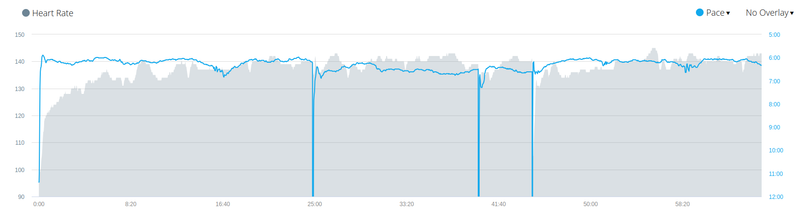
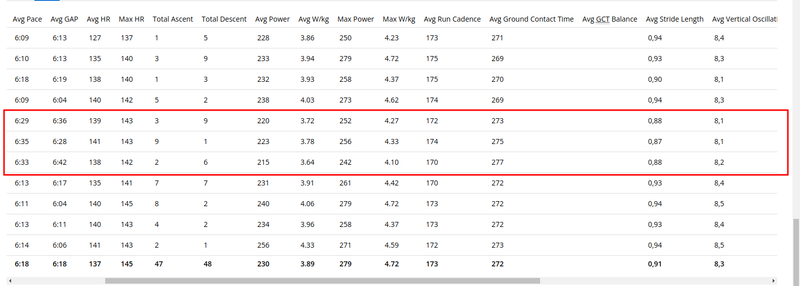
I ran barefoot maintaining the same effort as running in shoes. At the same effort and heart rate, my barefoot pace dropped by about 20 seconds (6:30 vs 6:10).
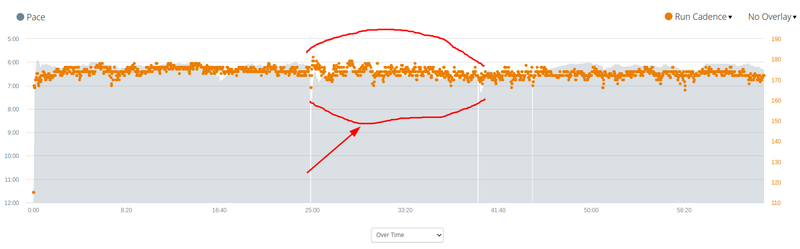
My average cadence remained the same (the spread increased slightly due to bumps, holes, sharp grass blades, etc.)
The placement of my foot didn’t change, the way I strike the ground didn’t change. I assume this is because I generally pay attention to these aspects in all my workouts. Honestly, the result was exactly where I expected it, which seemed disappointingly unimpressive.
What did change in the graphs:
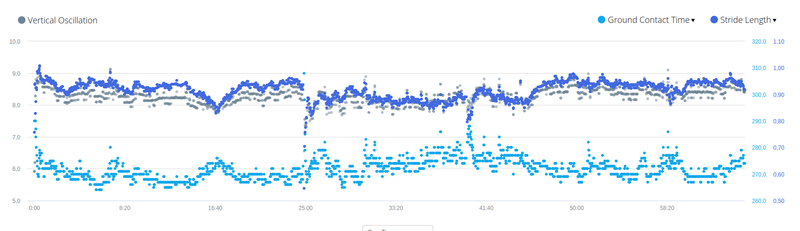
- Vertical oscillation decreased. In theory, this is good.
- Stride length decreased, which makes sense since my pace dropped at the same cadence. But the fact that this happened at the same perceived effort and heart rate suggests that this extra effort went into overcoming barefootness instead of moving forward.
- Throughout the barefoot section, ground contact time increased. This is not good. But this is explained, I believe, by another unexpected and unpleasant effect:
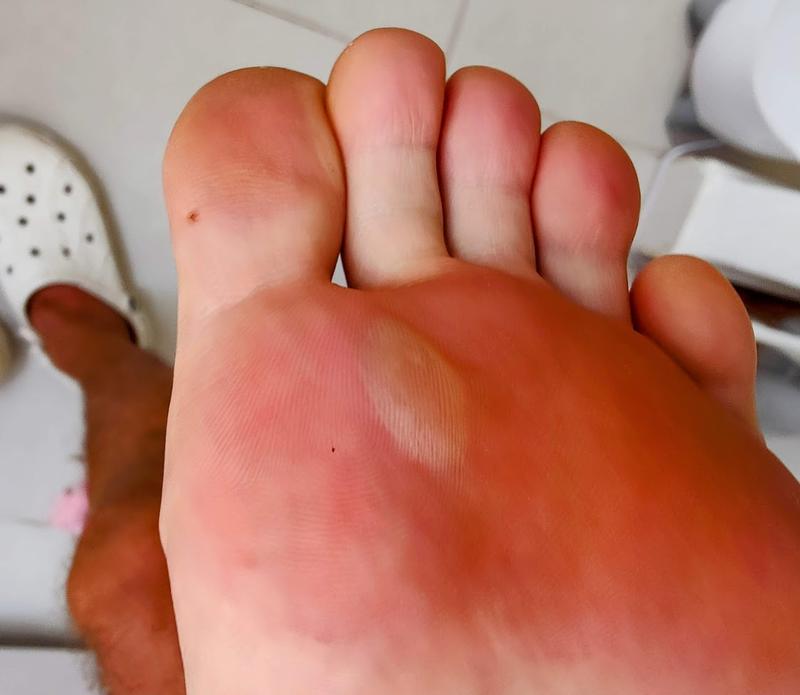
Despite spending most of the day barefoot at home, my feet turned out to be very tender, and after about 700 meters they rubbed against the ground like sandpaper and formed blisters. As a result, I wanted to hit the ground less often, and when necessary, not with the part that was rubbed raw (ball of the foot), but with the whole foot. What’s also funny, considering that barefoot running assumes we’ll start running with a forefoot strike, but I increasingly ran with anything but a forefoot strike.
The sensations from shoes afterward were very impressive. Felt like bouncing on marshmallows: rather pleasant than not.
Conclusion
It didn’t seem like I’d get any technique bonuses from running barefoot, but you can get foot strengthening, which is good. Plus the pleasant „esoteric” effect is pleasant enough to include barefoot running in my plan once a week.
Second Run
The blisters successfully burst during an interval workout the day after the first run, so I decided I could safely continue the experiment. This time we’re comparing slightly less different „footwear”: barefoot vs Altra Torin (zero drop, wide toe box). Ran on asphalt in shoes, on grass barefoot.
I note that my feet adapted to barefoot running already after just one run: this time no chafing, no blisters, ran without problems during and without consequences afterward.
Data
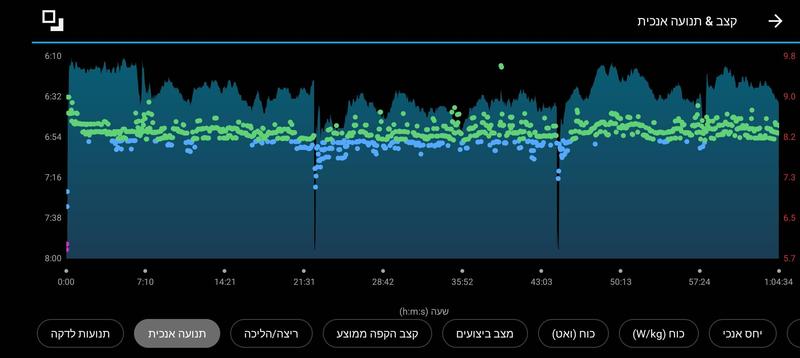
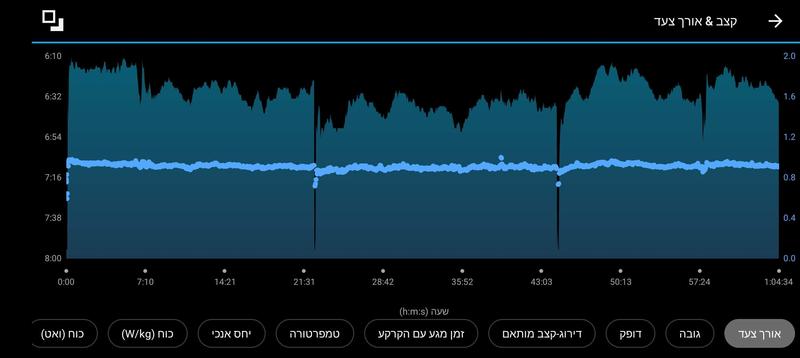
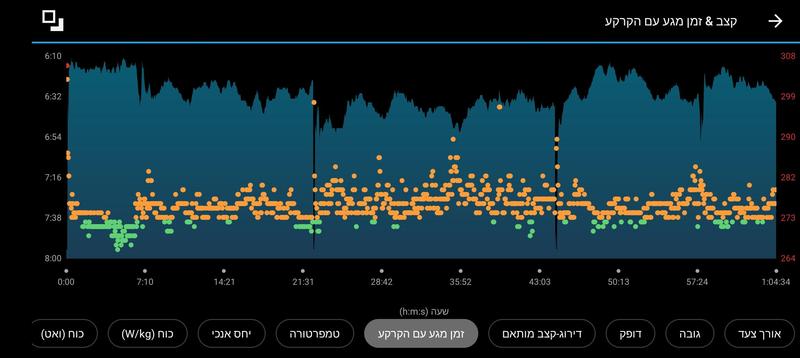
Looking at the data (made clearer segments, without autolap, to make it easier and more convenient to look at results), first segment in shoes, second without shoes, third in shoes:
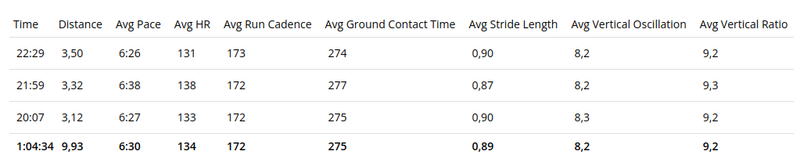
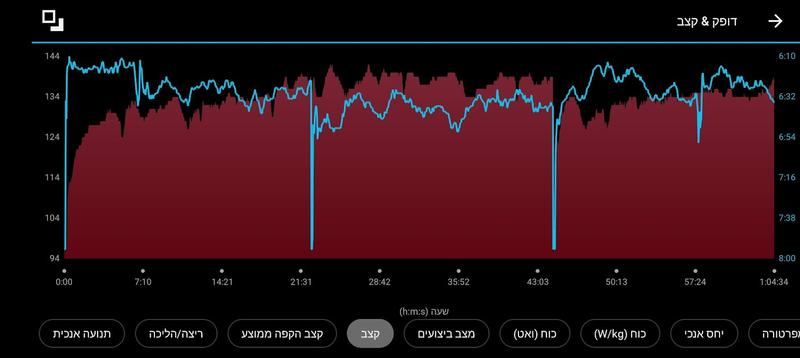
- barefoot pace ~10 seconds slower,
- barefoot heart rate ~10 beats higher,
- it turns out that barefoot running economy is again (still?) lower:
- average cadence is the same (but greater spread):
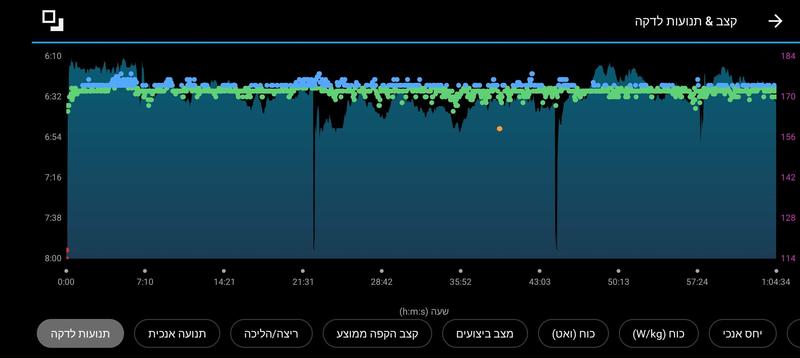
- vertical oscillation also has greater spread, but the average value is the same as in shoes:
- noticeable difference in numbers only for two metrics: stride length and ground contact time. Barefoot stride was shorter (not very noticeable on the graph, but minus three centimeters per stride :), and I spent more time on the ground:
Conclusion
Theory tells us that running engages two propulsion mechanisms: active, when we produce energy ourselves and contract muscles, and passive, when we accumulate energy when the foot strikes the ground and use it when pushing off (tendons and muscles work like a spring or rubber band). With the second mechanism, increased ground contact time leads to dissipation of accumulated energy, so it’s more economical when this time is less. Books told me that when running barefoot, this passive mechanism is engaged and works better 1 (but they usually compare barefoot running with regular shoes with high drop). In my case, however, the data suggests that as if I’m running barefoot less efficiently and using the passive propulsion mechanism worse than in foam shoes but with zero drop. At minimum, I’m dissipating more energy into the ground.
If we discard all the data and efficiency, it’s still surprising that by feel running barefoot is easier, despite the heart rate being higher at that time. This is a mystery.
TODO
When feet better adapt to barefoot running, try other variations:
- maintain the same pace on all segments,
- same surface on all segments (either always asphalt or always grass),
- compare readings at higher speeds.
- Experiment from coach: „run about 5km easy, without shoes from the start, and then add 1km constantly up to your race pace or as long as you can, and then to the finish already light. Interesting how your legs will feel: during the run, after, and the next day.”